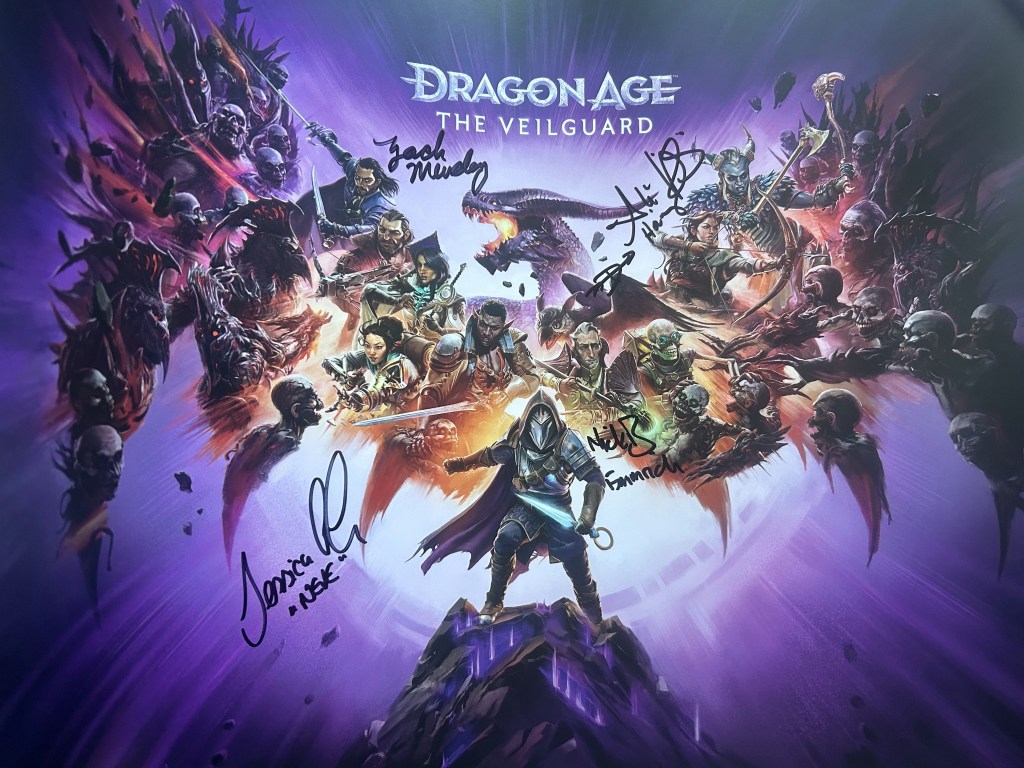
When the release of the new Dragon Age game was announced, after a long ten year wait, I was both relieved, that it was going to happen in my lifetime, and excited that I might get resolution on some of the story threads that had been woven through the previous three games.
Then, last summer, at San Diego Comic Con, a Dragon Age panel with voice actors from the games was scheduled. The Sis and I made it, met the actors, and got their autographs on an oversized print (see above). They were charming, and kind, and oh so positive about their experience and excited for us to play, that we left feeling hopeful for what was to come.
Fast forward a few months, and nearly everyone with an advance copy unleashed their negativity. I ignored all of it because I really didn’t care what anyone thought, I was always going to play it, and I would have my own opinion without being influenced by people who’s thoughts on it didn’t truly matter to me.
I didn’t buy it right away, which I sort of felt bad about, but I was deep into Baldur’s Gate 3, and I knew, regardless of how BG3 had me smitten, which was completely, I would turn away and play Dragon Age without a second thought. The Sis surprised me with it for Christmas, and after staring at it for a week, I succumbed. I finished my first play through, and I have some thoughts.
Strike that, I have a lot of thoughts. So many in fact, that I think I’m going to have to write this in (at least) two parts.
Sorry.
For those of you who have been with me for a while, you’re well aware of my relationship with the Dragon Age universe. I love it. I love the characters, the story, the lore, and the fandom because they create the most wonderful things. Not only do I have a bit of merch and write fan fiction, I also have a tattoo, and I don’t feel like I’ve even scratched the surface in any of those areas. I always want more.
When the first game, Dragon Age: Origins was released back in 2009, I hadn’t played a video game in years. I had had a lot on my plate for a while, but I saw a commercial for it and I knew.
I had to play it. And I loved it.
It was everything I liked – medieval setting with fantasy elements, dragons, magic, overwhelming odds, an eclectic band of heroes, while also being an RPG (role playing game), where your actions have actual in-world consequences – all the hours spent in this universe…it’s a decision I have never come to regret.
So let’s do a little overview of this world prior to the new game.
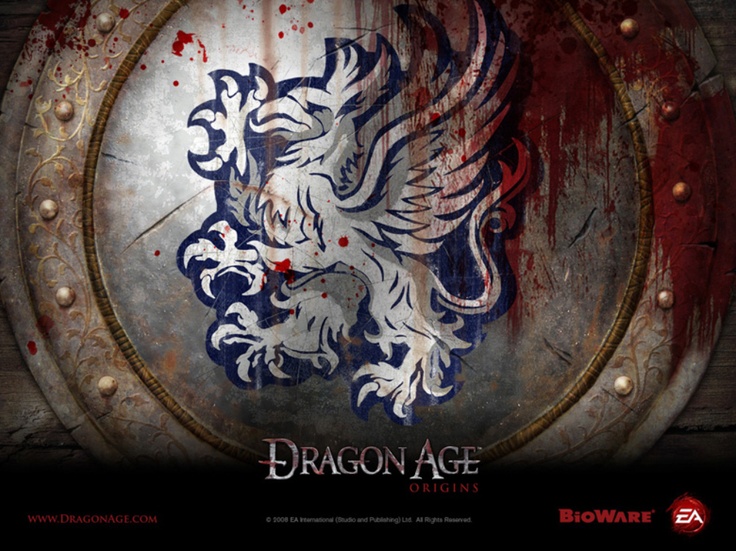
In DAO you choose one of six “origin” (human, elf, or dwarf) stories to play as, but no matter which route you chose, you end up being recruited to be part of an old world order known as the Grey Wardens. They are a fabled group, known for their sacrifice in the face of great evil, and in game one, the greatest threat, a Blight, is on the horizon. Hordes of darkspawn, LOTR-like orcs, are lead by an old god-turned dragon known as an archdemon. Only a Warden can kill an archdemon, and by game’s end, there are only a few of you left.
This was the introduction to this world and its people. It was dark and gritty. There were interesting characters, many of whom could be either recruited to your cause, or surprisingly, left for dead at the hands of fate, or your own. There were difficult decisions, and the story left a lasting impression.
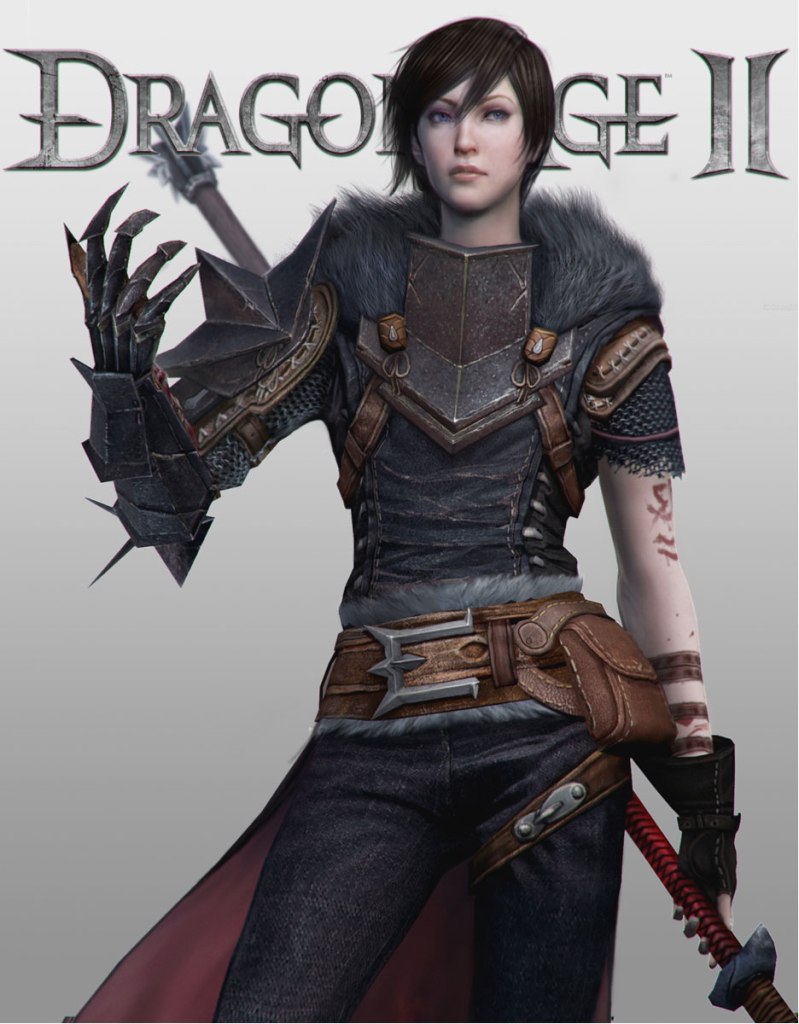
Shockingly, on the heels of the success of Origins, Dragon Age 2 was released only two years later to mixed reviews. You play as Hawke, a refugee fleeing the Blight with their family, who becomes a champion to the city of Kirkwall and its people. For most fans, the two big negatives for this game were the lack of choice of race for Hawke, you could only be human, and the reuse of floorplans. Every dungeon was the same design, but honestly, with only two years to create a whole game from scratch, I don’t have much of a problem with it.
We are, again, introduced to some of the best characters, many who continue into game three, and beyond, including Hawke who ended up as the fan favorite protagonist of the DAU. In Act 2, an object is discovered that creates one of the biggest plot points for this world, and a war between the mages and their overseers, the Templars, ensues which, in turn, sparks the events of game three. In one of the DLCs, we are introduced to a creature who is thought of as one of the first ever darkspawn. He plays a major role in game three.
Dragon Age Inquisition was then released just three years later and was an instant hit. It won Game of the Year. It was pretty to look at, it was a fairly large open-ish world, and there was a huge story. The characters continued to be amazing, and the romance aspect was so well done, you actually felt butterflies when you interacted with your love interest. There were political and religious implications, the Grey Wardens were being manipulated and thus had become a threat, and Hawke made an appearance to help.
One of your companions is an elf named Solas. He’s wise and a bit sad, and if you play as a female elf, he’s a romance option. No matter how you play, you learn that Solas is, in fact, an ancient elf, more like a god, known to all from history as The Dread Wolf, who’s responsible for creating a magical barrier that separates the mortal world from a magical one. It’s referred to as the Veil and it plays a part in each game in some manner. Solas is the puppet master of game three, playing out his grand plan from the shadows with the creature from DA2 taking the lead. By the end of Inquisition, a choice is laid out before you, save or destroy your friend, Solas.
So, with ten years in development, expectations for game four, previously known as Dragon Age: The Dread Wolf renamed Dragon Age: The Veilguard were high. Behind the scenes, for years, there was a lot of concern as people who had been with the developer, BioWare for a long time left the company. There seemed to be quite a bit of upheaval, and anyone associated with any of the previous games were no longer present. Updates were few and far between, there were large gaps of silence, and delays continued, bringing expectations down.
And then there was Baldur’s Gate 3.
I feel like it changed the landscape on the whole. It’s unlike anything I’ve ever played, and its release the year before probably had an effect on gamers. We saw what was possible, and now we wanted it, from every game we were going to play going forward, to some degree.
I haven’t read all the details of the behind the scenes drama, but as a long time fan of the series, I can say, without any bias from outside sources, that Dragon Age: The Veilguard is a disappointment.
I know. I’m sad about it.
There are a number of things to like, but they are slightly overshadowed by the negatives. The one that immediately stood out to me is that the game feels like it was designed for a younger audience. There was also a feeling of hand holding, if that a makes sense.
Since there were 15 years between the first and last game, you would think that the developers would have considered their fanbase and their advancing age. Yes, you want to make a game accessible to new fans, and old alike, but by game 4, with a continuing story line, maybe they should have kept that at the forefront of the process.
Okay, so that’s a lot of background, and I barely hinted at an actual review….oh my. I’m changing the name of this post, since it’s not that, not yet.
I hope you’ll stick around for Part Two.
 A Writer's Discrepant Memoirs and Other Tales