Accepting Who You Are

TypewriterFontWriterSo, I have something to confess.  I recently realized how time consuming blog writing can be.  For most of you out there, you’re probably thinking, “Duh”.  Sometimes I spend hours trying to get the words just right or the pictures to look just so, and I end up not writing anything else (– that’s the confession part).  I’ll have my Final Draft window open with the script I’m currently working on, but it does just that –it’s sits there, antagonizing me, reminding me of my lack of productiveness.  Now, I am a bit of a procrastinator and I’m well aware of it, but the things that have been going on this week, piling up, are not due to this condition.  I swear.  So I’ve come to a decision.  In the beginning, I was trying to write a blog a day, but as I’ve taken note of over the last few weeks, I can’t keep up (and neither can some of my readers), so, I’m going to write blogs only 3x a week and get myself back on track at writing my stuff everyday.  I think some of it has to do with that rewrite, you all know the one.  It has mentally worn me out.

So what does this have to do with accepting who you are?  In part, it’s about not feeling like a failure when things don’t go as planned.  It’s about setting boundaries and limitations because sometimes we try to do so many things that it becomes impossible to do them all without something falling to the wayside, then we feel bad, and that’s not a good attitude to have when we’re trying to be creative.  In addition to the big goals you may have set for yourself, it’s good to set smaller, daily goals that you can aim to achieve.  Whether it’s a word or page count, how many query letters you’re going to send out, or finding a handful of networking opportunities, set attainable “to do’s” that you can meet and feel good about yourself for accomplishing.  A positive mindset definitely encourages a more conducive writing experience.

You may have to do a little self-reflection, and come to terms with certain facets about yourself.  And I don’t mean only the negative things or those features you consider shortcomings.  If you acknowledge who you truly are, you’re more likely to use it to your advantage, and then who knows what you can accomplish.  Like my procrastination, that sometimes works to my advantage, but can also be stress inducing — I accept that about myself and try, with great effort, to not (always) allow that to rule my day, and yet, when the clock is ticking, my mind suddenly clears and there’s a spark of genius.  Okay, that might be a slight exaggeration, but I do find a strange clarity in those tense final moments (and blaring heart palpitations).

I found two different posts today from friends that reiterated this lesson.  If you’ve never taken a personality quiz before, this one from iPersonic, may be enlightening.  Then, there was a study about Why Creative People Make No Sense.  That made me feel so much better about myself.  Hopefully, it will clarify some things for you too.  We are creatives.  And that means we are complex creatures and we should be proud (maybe I’ll have tee-shirts made or start a support group).

Okay.  I am not going to agonize over this blog any further (P.S.  If you find any grammatical errors, please let me know!) and I’m going to go write.  Really.

Good luck to you and your writing endeavors!

*Image from DL Koontz site

Preparedness (The State of Being Prepared, For The New Screenwriter)

I’ve read that the best time for a screenwriter (and actors) is in the spring.  The holidays are over, it’s a new year, and the television industry is in pilot season and finding new writers to add to their staff.  So it’s best to be prepared ahead of time.  I already feel that this is going to be a two-parter.  As a “new” screenwriter, there are quite a few steps to getting your career off the ground.  You can’t, in all honesty, have only one script ready.  It is due in part to one major follow-up question that will inevitably be asked, “What else do you have?”  According to screenwriting career coach, Lee Jessup, you should have a well rounded portfolio that includes: 2-3 well crafted scripts all in a similar genre, 1 tv pilot or web series, at least 5 more ideas in your genre, and 2 more strong ideas outside your brand*.  *Brand, for a screenwriter means that we (our image), along with our work, are a product, and when you initially make your mark on the industry, it is how you will be recognized.  I currently write (mostly romantic) stories with fantastical elements, so my brand is the fantasy genre and I plan on wearing a lot of pink.  At first it might seem like a pigeonhole, but from what I’ve read, it’s an asset — you could be the one the big-wigs come to for help when a screenplay needs a rewrite in a similar vein as your own style.  Many screenwriters fill their time and make additional income by being script doctors, reliable rewriters (look up Carrie Fisher).  Tip #1 – Keep writing!  Tip #2 – Start developing your portfolio!

So you have your portfolio, somewhat in order.  Then you have to write a query letter and find an agent.  If your networking has been successful, you may already have a lead on an agent.  You’ll quickly learn it’s much easier to get through the gatekeepers (assistants) if you have an “in”.  I have a friend who has referred me to his agent, and as soon as all my little ducks are in a row, that phone call will be more effective.  If you don’t have any contacts, the next best thing is a well written query letter.  There are numerous sites with useful information available, here’s one from Script.  Then there’s the research into finding an agent taking on new clients.  The Writer’s Store offers a directory, updated a few times year, with just this information for a small fee.  Finding an agent will have to be a whole other post or three.  Tip #3 – Craft a query letter!  Tip #4 – Generate an agent/producer/manager list!

And then here are a few more things to be aware of:

5. Your image

6. Become an expert (It’s the ace up your sleeve – be it dialogue, genre, character development, a time period, what have you…)

7. Read the trades (be aware of what’s happening in the industry – Variety & The Hollywood Reporter)

8. Create a list of writers you like, their work, and writing tricks/storytelling techniques they use

9. Find networking opportunities

Okay, that should get you all started.  *Wink.

Have a great weekend!


A Journal Entry & A Few Tips

Where do I begin?  I’m still waiting to hear about the writing fellowship I applied for, which is an enormous source of anxiety at the moment.  It’s a great opportunity and I really want it.  I constantly check my email and their Facebook page, which rarely receives an update, and as I gnaw my bottom lip into oblivion and incur a few more gray hairs, I find it hard to concentrate and continue working.  A friend offered me words of encouragement and support in regards to my writing, and to keep looking forward to the next opportunity, but I would greatly appreciate a favorable outcome on this one.  Like most writers, I have a backstory filled with dysfunction and hardship, and there are only so many circles in Hell, so at some point the bottom has to curve back upwards, right?  Okay, my pity party is over.  Back to the topic at hand.  I don’t like limbo mode, and until I know one way or the other, I seem to have had the wind taken from my sails.  I know I’m putting too much stock into this one prospect, but after taking a few knocks this year, I’d like to remember 2013 as the year this amazing thing happened.  It is exactly for this reason I should pour myself into my work, yet here I am, trying to give myself a mental kick in the writing pants.  I should focus on my angst-y protagonist and get her into some butt-kicking scenarios.  That should relieve some stress…this is really just a journal entry, a reminder for my future self.  As writers we struggle.  I think it’s a rule or a genetic defect or a gypsy curse, that we must struggle (physically, emotionally, creatively) in order to be better artists.  And sometimes we just need to vent about it.

On a completely different note, when I returned from the long holiday weekend, I had over a dozen webpages open to read, with more deleted immediately and others bookmarked for future reading.  With the end of the year quickly approaching, numerous sources are offering their year end reviews, best of’s, items of noteworthiness, and ways to start off the new year, etc.  I thought I’d share The Writing Whisperer’s 50 Ways Writers Can Prepare For The New Year.  I think it’s important to set new goals each year (one of the things listed).  I was always terrible at keeping my New Year resolutions, until I was a little older and determined to change my ways.  I’ve mentioned how I put together my own Professional To Do List that includes over 20 items.  I attacked it with voracity initially, but have let a few things lapse (some are time sensitive, some require an investment) until the new year, when I come out of the gates charging.  I find that writing down your goals and posting them, rather than just mentally taking note, is more effective, since it’s staring at you (depending on where you stick it – mine is right beside my monitor, and it is always eyeballing me).  Simple changes, like buying a new journal or pen, taking a little time out to organize/purge your computer’s desktop, your actual desk, and your writing environment can make you feel better or possibly inspired, because who knows what you’ll find.  I’m a little OCD when it comes to being organized, so that’s not an issue, but I would like a new desk, maybe I’ll ask Santa for Christmas.

I hope your week is less stressful and more productive than mine.  I know I’m more productive at night, when my house is finally quiet, so I should take advantage and dispose of some of this angst.  Let’s see what comes of it.

Best of luck to you all!


Writing 101 And A Little Rant

I hope everyone had a wonderful Thanksgiving weekend!  I’m just back myself and have to pull myself together after the little getaway.  I find it ironic that the day I posted a blog about finding some time to write when you don’t have a lot of time that I lost all of mine.  I went away for the long weekend and found myself without an opportunity to do any writing.  I fell asleep each night exhausted from the day’s events, and barely had a moment to think of any ideas let alone write anything down.  I took my writing journal and it never saw the light of day.  So here I am, putting my nose back to the grindstone, because I have some making up to do…although, I’ll probably need to start out slow.  Whew, I’m still tired.

I saw this chart today, The Seven Steps to the Perfect Story, and thought I’d share.  Since storytelling has been around since the invention of language, obviously there are some components that are required and we need to be aware of them.  The foundation for these principals can be found in  Joseph Campbell’s The Hero with a Thousand Faces and Christopher Vogler’s The Hero’s Journey (Vogler’s book was inspired by Campbell’s)which I believe are essential reads for any writer.  As I’ve said, and I’m sure you’ve heard time and time again, you have to learn the rules in order to break them.

I’m not sure if I’ve mentioned this before, but if you want to do something, like write or play music or paint, I think it should be part of your education and knowledge base to know the history and evolution of the field you want to be a part of and those that came before.  I met someone who wanted to be a filmmaker, but wouldn’t watch anything prior to the 70s.  The art of film is only a little over 100 years old.  There have been great advances in technology that have therefore advanced filmmaking, but you need to know the basics, and some of my favorites are from the 50s.  How can you call yourself a filmmaker without any knowledge of 75% of the field?  It goes without saying that I did not continue that friendship.  It’s like wanting to be a guitarist and not knowing who Jimmy Hendrix is?  Or wanting to be a writer but you don’t want to read.  Nonsense.

So as the madness of Black Friday and Cyber Monday come to a close, while we wait for more holiday madness in the coming weeks, I wish you all the best of luck in finding a few quiet moments to do what you love.

Have a good week!

The Holidays Are a Time-Sucker

The time-sucking holidays are upon us.  And today I was just all over the place, literally and mentally.  Preparing for Thanksgiving, car problems, and regular life stuff.  I had started a blog earlier in the day, got sidetracked, and now here it is, 1:30 am, and I’m just getting back to my computer.  I had planned on working on one of my pieces…maybe in a bit.  But I know I shouldn’t stay up too late, because I have another full day ahead of me.  Where does the time go some days?

The pitfalls of the holidays; family, friends, festivities, and plenty of “excuses” to not get work done.  Finding time can be difficult without letting other things fall to the wayside.  So how and where can we find a few extra minutes in our day?  This depends on each of our schedules and what we’re trying to accomplish.

1. Maybe we get up a little early or stay up late and write if even for just 15 mins while everyone else is asleep.

2. Maybe we can write a little during lunch.  Bring our lunch to work and find a quiet corner where we can eat and write in peace.

3. I like those little tape recorders that you can voice your ideas into when you’re driving or grocery shopping or waiting anywhere so that way when you do have some time, you can write down those fantastic little gems that always seem to come (to me) when (I) don’t have the opportunity to actually write them down.  Or use it to generate whole paragraphs, scenes, characters, outlines, etc.

4. If you do have the opportunity to make notes throughout the day, be sure to keep a notebook and pen with you at all times.  I’m also a fan of the notes app on my phone.  It never fails, I’m half asleep and something will pop into my head.  I can’t get up.  It’s cold.  It’s dark.  And I have two dogs snuggled up beside me.  So, I grab my phone with its built-in night light and jot down that idea before it disappears.

5. DVR a few shows and write instead.

6. Ask for some time from those that depend on you.  Ask for help around the house.  Make everyone do their “homework” at the same time.

7. Cut back from the internet.  This is a hard one to do, because if you’re like me, you write on your computer and that internet is just staring at you, enticing you to look into its goody bag.  We use it for research.  To find inspiration.  To lose all track of time.  I know it may be difficult to quit cold turkey (holiday pun intended) so just limit your time.  Only go on in the morning or at night and give your self a time limit.  If you know you have to look something up, do it right away and don’t get sucked into the click happy vortex.

I don’t know…these are just suggestions, but I know the time will add up and regardless of how much you accomplish each day, you are still moving forward, still progressing, even if it’s not at the same rate you would normally write.  We can’t feel too guilty at this time of year, because our time is divided, and ’tis the season of giving.  We spend a lot of time on our own, in our own worlds, so we should enjoy the holidays, and surround ourselves with loved ones, because it only lasts a few short weeks..and then we won’t have any excuses.

Have a good week!

A Big Thank You and A Little Insight: Fate(s)

Psyche Entering Cupid's Garden

Today I hit 50 followers and I’d like to say Thank You!  So I thought today might be a good day to share a little bit about myself and my writing, starting with my first script, Fate(s).  The first draft, which was horrible by the way, was written in one of the first screenwriting classes I took when I returned to college.  I’m not really sure how it all began, but over time, it has morphed, inspired by actual events and a few outside sources.  Here’s a little backstory.

Ares

I know a little of the inspiration came from a few sources like the Greek Mythology class I took in 8th grade, where I first became fascinated by mythology, Hercules: The Legendary Journey tv show (I based my Ares, god of war, on the actor who portrayed him on the show, Kevin Smith), and Disney’s Hercules.  But the major influence came by way of real life.  A little over six years ago, my sister and I had moved to Phoenix, and I was working in this little bistro.  One day, a man walked in and I was overcome with a feeling unlike anything I had ever felt before (or since).  I became so nervous.  It wasn’t just that he was good looking, there was something else about him.  I remember using the word “twitterpated”.  Three times he came in, and three times I let him go — an enormous regret that I allowed fear to say or do anything more than take his order be all that stood between me and ever seeing him again.  So I put my angst into my script.  His name is Nicholas, and so I renamed my hero.  *Nicholas, if you’re out there…I’m in LA now…sigh.

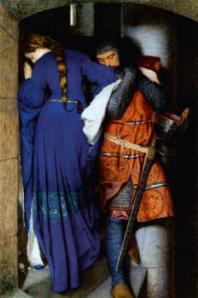
Lovers Meet on the Castle Stairs

Fate(s) is about a young couple, who meet three times in three different lifetimes, thwarted of their happily ever after by the intervention of the Greek gods for their own amusement, which leads the world onto its present course.  It is the lack of destiny fulfillment, which the Fates have set forth, that causes disruption in the natural order of things; i.e. The Fall of Rome, The Black Plague, and the subsequent wars and devastation.  According to The Fates, some are necessary, but others will progress because of these interferences.  As there is a three strikes rule, my couple and The Fates have to take some drastic measures, align with an unlikely ally, and overcome mythological obstacles to find true love and restore balance or all might be lost.Theberge-Women in Love II

So there’s a little about me and how life can inspire your work.  It isn’t a stretch to imagine what my heroine is feeling when she says “she longs for someone”.  This is the story I have referred to recently in my rewriting posts.  It was this third act that continued to give me problems, and it is this one that I want to go out into the world and do great things.

Have a great weekend everyone and Thank You again!

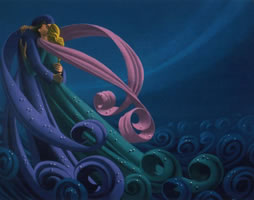
*Images: 1. Waterhouse’s Psyche Entering Cupid’s Garden which I consider my touchstone piece; the image I hold dear while I write. 2. Kevin Smith as Ares.  3. I do not know the artist or the title.  If you do, please let me know.  4. Theberge’s Women in Love II, which is a bit small and hard to find, but I love it!  All of these images are inspiration for this particular script.

More Screenwriting Tips and a Friendly Word

TypewriterFontWriterI recently wrote a post entitled Novels vs Screenplays, but it really should’ve been called Screenwriting 101.  Then I saw this article from Script Magazine, 15 Screenwriting Mistakes to Avoid.  It was too timely not to share.  For those of you interested in screenwriting, this article exposes some of the pitfalls you may be unaware of.  And then there was this, Notes from the Margin.  Somebody sounds a little cranky.

Yes, there are plenty of people out there trying to tell you how to do things, and yes, some rules like formatting exist for a reason (because they won’t give you a second glance if it’s not correct), but I am not here to tell you how to write.  I’m only sharing part of my process and tricks I’ve learned along the way.  I long to be part of a community that shares insight, offers advice, recommends opportunities, and above all else, encourages.  I want people to succeed if their passionate about their work.  Writing is not an easy path, and only other writers will understand the struggles we face each day.  I have friends who are still floundering in finding their purpose, and I am thankful, even when I’m at my wit’s end, that I have found my passion.  I have faced opposition from family and friends and I’m not sure if it’s fear or jealousy, but “those that discourage your dreams have likely abandoned their own” (I don’t know who said this, but I have it tacked on my wall).  And this is one of the reasons we should surround ourselves with those that are like-minded.

So when I say, “Best of luck in your writing endeavors”, I truly mean it!  Good luck!

*Image from DL Koontz site.

Writing and Music

Music&Writing (Zemanta)I am a big proponent of listening to inspiring music when you write.  Depending on the writing, be it a romance, adventure, or thriller, the music you listen to should be a compliment to that style.  For my romantic pieces I usually listen to classical, or what’s considered new age — wordless.  For the spy script I’m currently writing, the music has been a bit more intense — sometimes without words, but with a harder sound (Depeche Mode and Muse have a few wordless pieces that are great for writing to), or some techno and rock.  I’ve also created playlists based on tv shows or movies I’ve liked with similar interests like La Femme Nikita and Alias for my spy script, or Pride & Prejudice and A Single Man for my more romantic pieces.  Just think about what music has done for you in your life.  You hear a song and can be reminded of your childhood sweetheart, your grandparents, graduating high school, or taking a road trip.  I have a few songs that remind me of backpacking through Europe, because I only took two tapes (yes, tapes) for six weeks.  Or when you hear a song you saw in a movie and are right back in that moment and its corresponding emotions.  I mean who doesn’t want to cry whenever they hear a Sarah McLachlan song?  Music is powerful.  It inspires.  And it brings people together.

I know some writers that must have quiet when they write, but I find the silence more distracting, and depending on the time of day, and your writing environment, the outside noises can be more intrusive and a major concentration breaker.  I’ve created multiple playlists on both iTunes and YouTube that I can go to depending on the particular piece I’m working on.  And YouTube is great (and a time sucker) for sharing other music similar to that which you’ve just listened to.  And I love being introduced to new stuff, so when LitReactor shared this article, 9 Great Albums to Accompany Your Writing Process, I was immediately intrigued, and found a few new pieces to add to the collection.

I like the symbiotic nature of writing with music.  I have been given strong visuals to pieces I’m working on when listening to certain music.  I remember writing this romantic period piece while listening to Enya, The Sun in the Stream, in particular.  She is my go to artist when I write.  It was a series of visuals; walking through a vast golden field, a wild castle garden, and two men in a castle courtyard practicing with swords while a woman lingered above watching.  Still to this day, whenever I hear this song, I see these images.

Everyone has their method, and if you’re a writer who likes the silence and it works for you, then don’t let me tell you otherwise.  For me personally, music is so much a part of my life, in every aspect, that it is only natural for me to listen and be inspired further.  I only wish I was better at playing music myself.

Have a good week and best of luck in your writing endeavors!  And thank you to ItalyEnya for the upload!

*Image by Zemanta

Taking a Little Respite

Some days are rough.  Not just for writers, but for people in general.  There are just so many days when you feel like all you’re doing is swimming against the current.  Being an adult is hard.  So much for high school, even college, preparing us for that wake-up call (no, this is not new to me, I’ve just been reminded again recently).  As for being a creative, those days seem doubled, maybe even tripled.  We have our regular lives, then our creative ones, then the professional ones where we try to get people to notice the creative one.  It’s a constant uphill battle with some little demon at the top throwing down boulders, pebbles, entire buildings…all while laughing at us and our torment as we try to achieve success.

I took my weekend, then as the new week dawned, I started to feel this dread.  As I wait to hear about a writing fellowship I applied for, the whiff of a negative thought has started to worm its way in and make me question my skills.  I had wanted my first screenplay entered as my “sample”, but it wasn’t ready.  I love the script I did submit, but the story is not as unique as the other, although it has spurred me to write two sequels (there’s just so much to write about), and now I’m wondering if that has inhibited my progress in some way.  See, there’s that little demon, working his evil magic.  I realize I haven’t really started to put myself “out there” as a writer until this past year, and the knocks have taken a little getting used to, but as the days compound, doubt creeps in, and I think stepping away from it all to get my head back on straight is the best remedy.  Besides, most people get sick days, so should we.  And then I found out about another approaching deadline, and right now my mind is a blank.  Six weeks…and I’ve got nothing.  And then there’s this potential writing job on the horizon…this is when I decide to have a creative/mental meltdown?!  I don’t have time for this nonsense.  Number one on my professional to do list is to treat my career as if it were already my profession.  So it’s time to get back to work.

Needless to say, I decided to take one “mental health” day.  I completely vegged; no cleaning, no worrying, not even a glance at my computer.  As this blog is meant to serve, in part, as a journal, I’m putting this out into the world and as a reminder to my future self of the times endured and overcome.  Here are a few quotes to help those of you struggling as well.

“Many of life’s failures are people who did not realize how close they were to success when they gave up.”  — Thomas A. Edison — So don’t give up!

“The only thing that stands between you and your dream is the will to try and the belief that it is actually possible.” — Joel Brown — Believe in yourself!

“If opportunity doesn’t knock, build a door. “ — Milton Berle — Create your own success story!

GoldenCKey

You may have noticed I have a thing for keys.  I like the metaphor they represent.  Let it be a reminder that we hold the keys to our success.  Throw rocks back at those demons, whether in reality or in your subconscious, and persevere!

Best of luck to you all!

Novels vs Screenplays Pt. 2

FlyingLettersSo continuing on…I recently added my own insight into a discussion regarding the nature of screenplays.  A writer was finding it difficult to follow the screenplay formula and not leave the reader confused.  Screenplays involve a lot of blank page, little description, and subtext to limit dialogue…a whole, action packed story, all in under 120 pages.  As I stated in the previous post, 1 page of screenplay roughly equals 1 minute of screen time.  So, those romantic comedies that are always around the 1 1/2 hr mark are about 90 pages.  Again, there are exceptions to the rules.  That’s why the phrase “rules are meant to be broken” is so well loved among screenwriters.  But, you have to learn them first.

When I started writing, I tried writing longer stories.  What I found inhibiting was the attention to details.  Where does the story fall among all those descriptions and idle moments.  When I was introduced to screenwriting, that it was it for me.  Don’t misunderstand, I love to read.  Getting lost in a book is a great way to spend time.  But, as a writer, I find I’m more effective in screenwriting.  Since I began screenwriting, I tried my hand at transferring one of my ideas to novel form, and it took great pains to switch the brain to that mode.  But here’s something I learned along the way.  Because I had to expand the story, I learned more about my characters, their thoughts, their feelings, and the plot became more involved which in turn caused me to rewrite the screenplay.  The two worked better together, in this case.  (This may need to be another topic of discussion.)

So here are a few things to keep in mind if you’re writing a screenplay:

1) Description should be bare minimum.  Only those things that add to the character should be mentioned.  The director and casting agents will decide on who gets cast in your roles, so don’t over-describe what they look like.  Same goes for clothing.  A few references to add to the character are useful, but can be eluded to easily without spending a lot of time on it.  If your character works in the fashion industry, most readers will have some understanding of what type of looks are involved in that world.  And you only have to mention it once when you first introduce your character.  I have an “angsty” teenager in one of my scripts and I just mentioned that she wore all black.  That’s it.  Our imaginations can conjure up an image without going into great detail.  Sometimes locations will be altered, for multiple reasons, so don’t waste time with a lot of description here either.  But let’s say your character randomly quotes movie lines, then perhaps you can write that they have old movie posters around their apartment.  But don’t tell us what color the walls are.  If your characters go to a country house in England, again, we can pretty much imagine that.

On the flip side, if your story takes place in an “alien” world (and by alien, I mean anything out of the ordinary.  It could be a secret military base, or a parallel world), then yes, you may need to describe things a little more in detail, but try not to go over the top, because Hollywood readers (from what I’ve heard) will sometimes just skim over long blocks of description because it takes away from the flow.

2) The same is true of dialogue.  Screenplay dialogue does not always mimic real life conversations.  You can leave out traditional conversation fillers like “hello”, “how are you”, “have a good day”, etc., again, unless it’s adding to the subtext.  Maybe we’re meeting the villain for the first time and he’s unusually cordial and it makes everyone uneasy.  Or a couple has just had a fight, so their conversation is a little stilted as they try to get past the tension.  There’s a phrase to remember in writing, “Enter (the scene) late, Leave (the scene) early”.  Think about it as if you were attending a party.  You get there an hour after it’s started.  You don’t know what happened before you arrived, so some of the conversations you overhear are just strange.  When you leave, the same thing can be said.  The last line of dialogue you hear uttered may leave you questioning what just happened.  Not everything needs an explanation.  Maybe it’s foreshadowing.  Maybe we just learned how other people view our character.

3) Try to conserve words.  If you can use one word instead of two and achieve the same intent, do it.  120 pages isn’t a lot.

4) Lastly, over describing action is unnecessary as well.  I remember reading once that in the film Crouching Tiger, Hidden Dragon, there was an elaborate fight sequence that was written only as “They fight”.  As writers we see the entire sequence in our heads, but leaving out some of the details does not necessarily mean it will weaken your story.  Obviously, you can write a little more than that, such as, “a fight that ensued through every room” or “an intense fight that seemed to last hours”.  A film involves so many more people, all with specific skills, and it is this knowledge that allows you to just tell the story.

This was a long one…goodness.  I hope it was helpful!  If you have any questions, feel free to send me a message.

Best of luck and have a good weekend!